Ship features. Bob finds the bugs and mends them in gold.
Kintsugi turns IBM Bob into an autonomous QA engineer. It reads your codebase, writes Playwright end-to-end tests, triages every failure with watsonx.ai, and heals the code until the suite is green.
Powered by watsonx.ai · IBM Cloudant · IBM Cloud Object Storage · No test-writing required
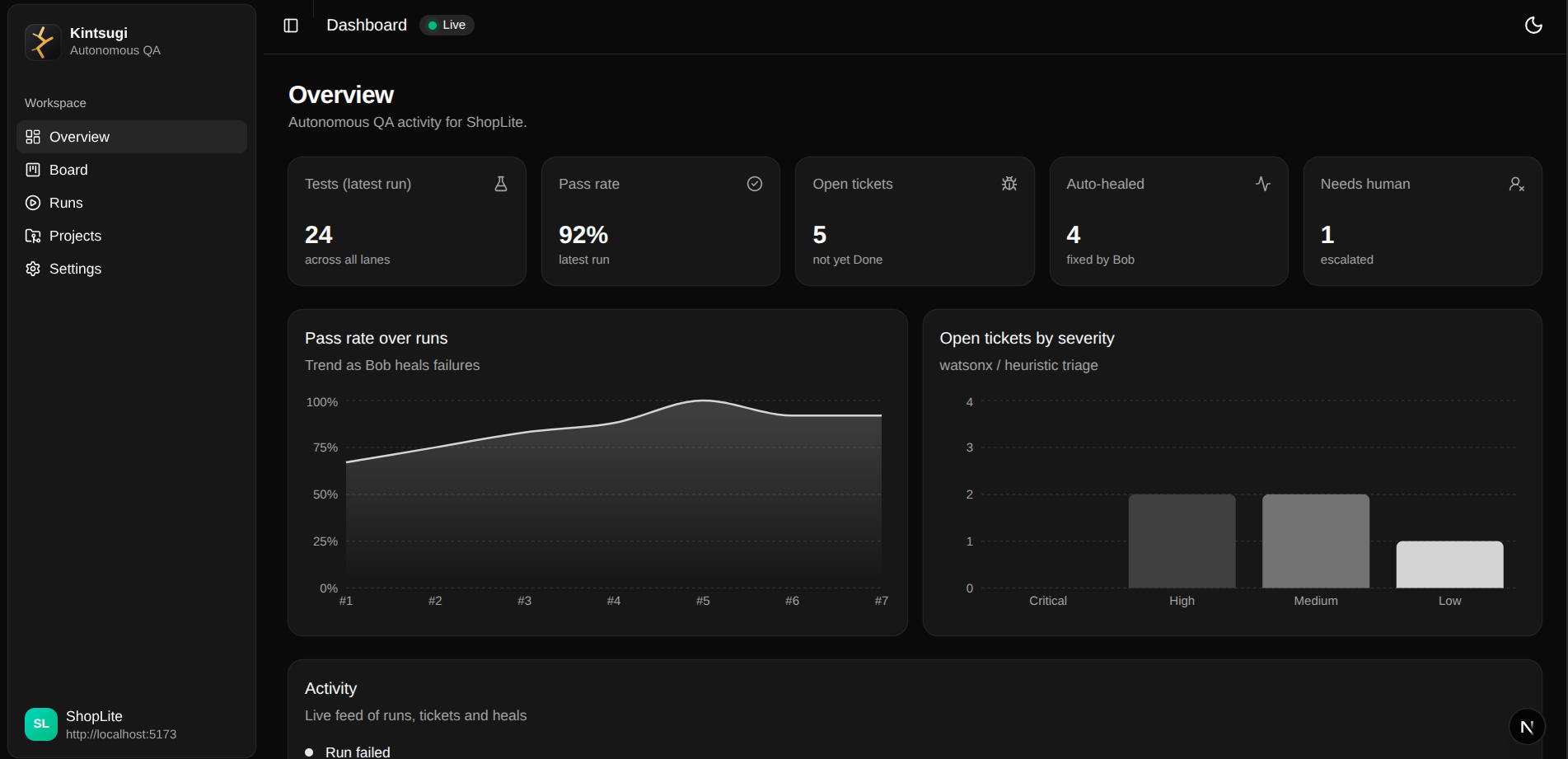
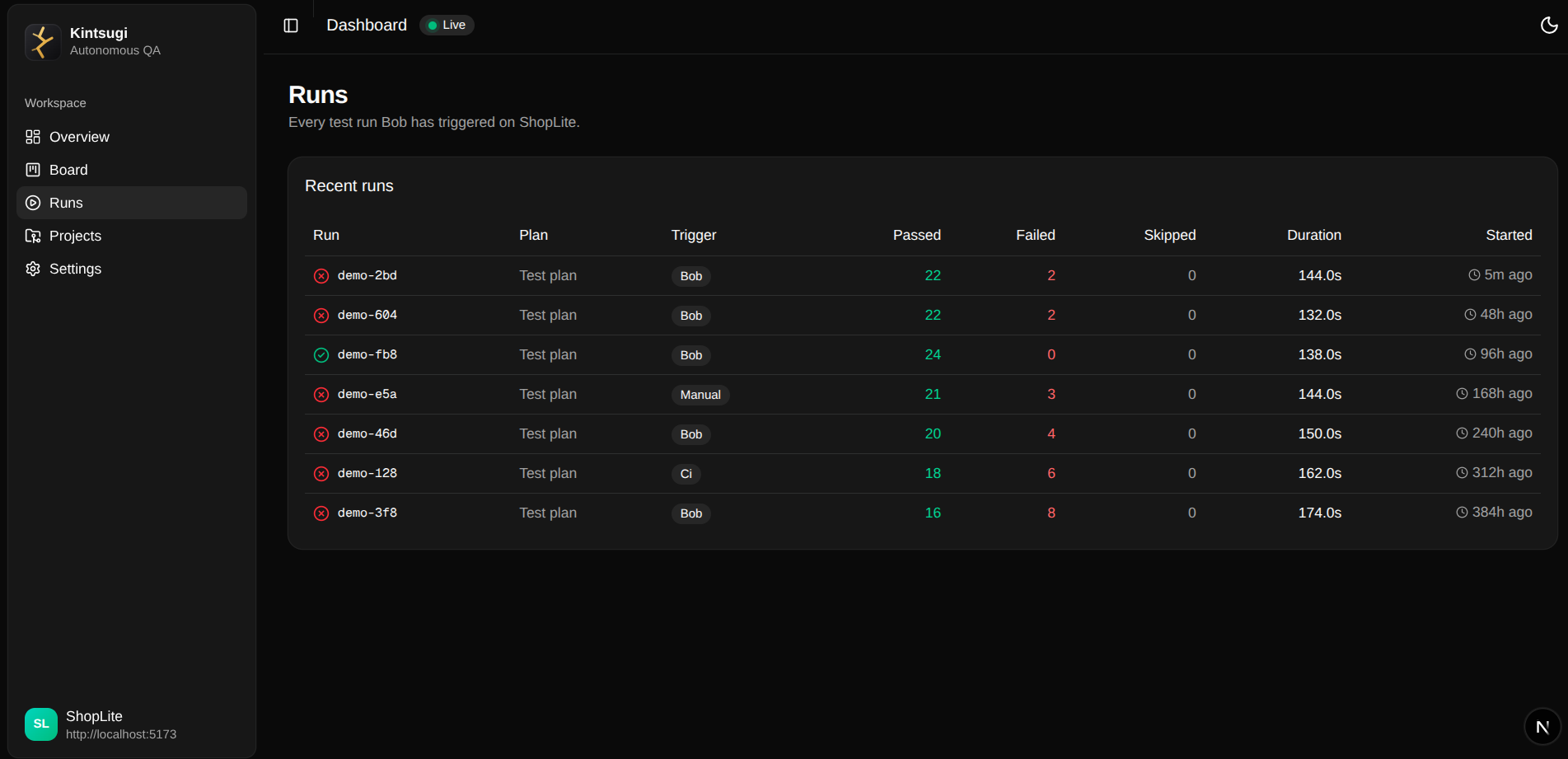
From red to green, on its own
Analyze
analyze_app crawls the running app into a route map and Bob reads the source.
Plan & write
Bob designs lane-based E2E plans; subagents author Playwright specs.
Run & triage
Tests run in the MCP sandbox. Failures → screenshot → watsonx triage → ticket.
Heal
The healer fixes the app code and re-runs each test until the board is green.
Two Bob modes.
One autonomous QA loop.
Kintsugi ships as custom Bob modes, rules, skills, and an MCP server — a complete QA agent.
Plans, writes & runs the tests
Crawls your app with analyze_app, designs lane-based E2E plans, and writes Playwright specs — executed through the MCP, never a shell. It can only edit test files.
test("checkout requires email", async ({ page }) => {
  await page.goto("/checkout")
  await page.getByRole("button").click()
  await expect(err).toBeVisible()
})AI-triaged failures
IBM Granite on watsonx.ai assigns each failure a severity, root cause, and suspected files — with a heuristic fallback.
Root cause · form submits without validating the email field; the order proceeds with a blank address.
Fixes the code, re-verifies green
Given a failing ticket with full evidence, it repairs the application source and re-runs the test via rerun_test until it passes — and never weakens a test to do it.
-if (email) submitOrder(email)+if (!isValidEmail(email)) {+ setError("Email is required")+ return+}+submitOrder(email)
Live Kanban board
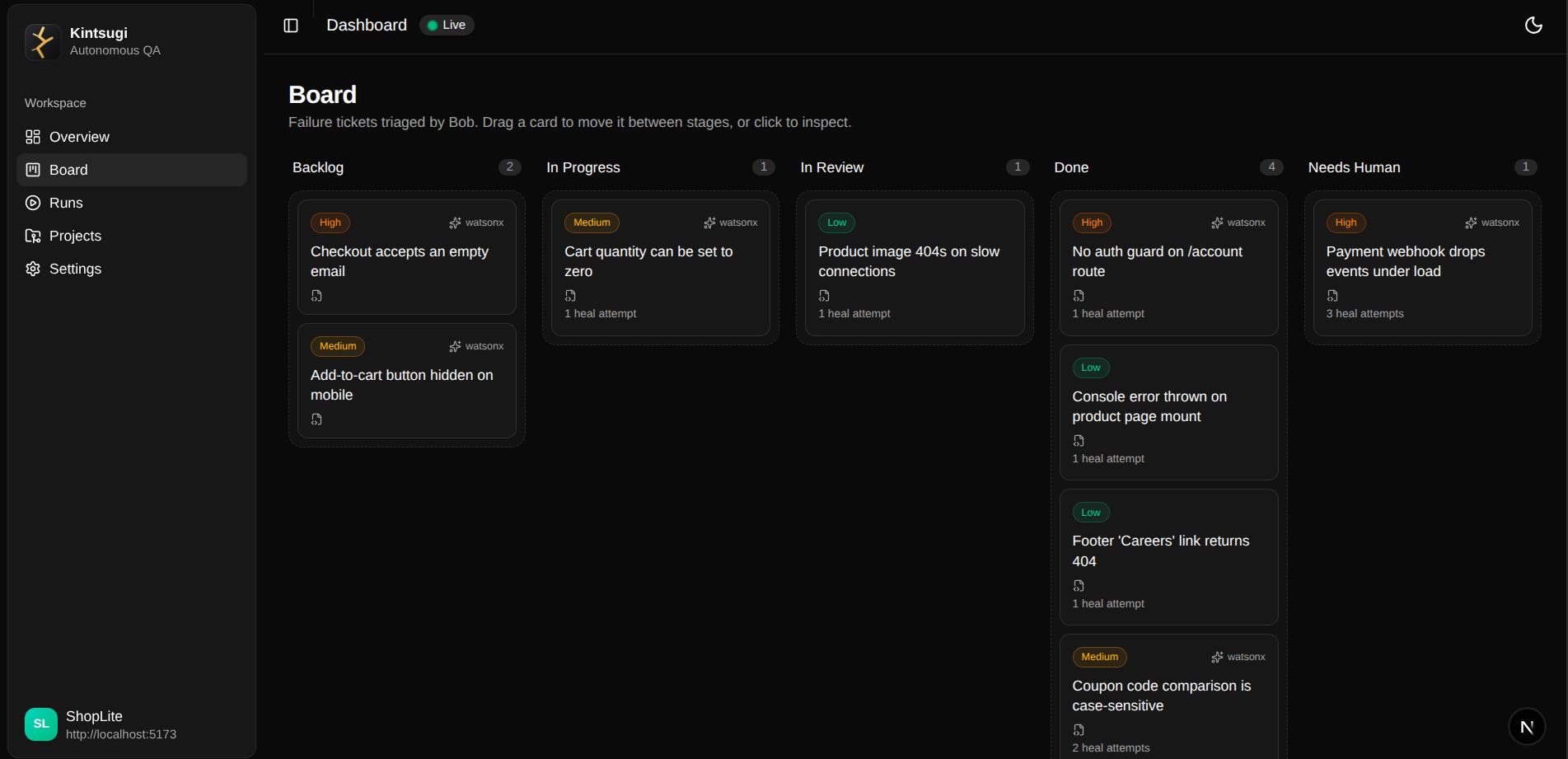
Failures land as tickets with a screenshot, severity, and triage — moving Backlog → In progress → Done as Bob heals.
MCP + Playwright sandbox
The Kintsugi MCP server runs Playwright behind a host allowlist and a test-dir jail. Closing Bob's shell is the core safety property.
IBM Cloudant
Plans, runs, results, and tickets persist in IBM Cloudant — the live source of truth behind the board.
IBM Cloud Object Storage
Screenshots and traces upload to IBM COS as tamper-proof evidence attached to every ticket.
Five skills, wired into Bob
Kintsugi installs two custom modes, five slash-command skills, mode rules, and an MCP server — so QA lives inside Bob, right where you already work.
/qa-init
Scaffolds the .kintsugi workspace and checks Playwright prerequisites — sets QA up without running anything yet.
/qa-run
The full loop: plans, writes, and runs Playwright specs through the MCP, then opens a triaged ticket for every failure.
/qa-test-writer
The spec-authoring conventions — structure, imports, selectors, assertions — auto-applied while Bob writes test files.
/qa-heal
Diagnoses and fixes the application code behind a failing ticket, then re-verifies through the MCP until it's green.
/qa-report
Generates an HTML run report and summarises the latest run and the state of the ticket board.
Two guardrailed modes
- 🔧kintsugi-qa — may edit test specs only. No shell.
- 🩹kintsugi-healer — may edit app code, never tests. No shell.
Frequently asked questions
Everything about how Kintsugi turns IBM Bob into an autonomous QA engineer — how it runs, what it can do, and where to start.
No. In kintsugi-qa mode, Bob reads your app, plans lane-based coverage, and writes the Playwright specs for you. You just run /qa-run.
Let Bob keep your app green
Open the dashboard, connect a project, and run /qa-run in Bob.